A reader's response to materials presented for EN398, spring semester.
Sunday, April 10, 2011
Where have all the good men gone, and where are all the gods?
As they ate pieces of sugar cane in the fields, Butch told Mattie to "spit it out while it's still sweet". Not only does this foreshadow their relationship, but it also illustrates a theme of movement and rearrangement that differentiates between men and women in The Women of Brewster Place. Butch spends the sweetest times with Mattie, enjoys the physical pleasure of the moment, then gets out before her father finds out and the baby must be supported. He doesn't get away while the sweetness has ended; he leaves while the sweetness is at its peak.
In many ways, I feel like this typifies many of the men in this novel. So far, only Kiswana's boyfriend is a good man, and he has yet to make a physical appearance (up to where I've gotten). The rest of the men are abusive, neglectful, lustful, animalistic, and negligent. The theme of illegitimate fatherhood runs through the work, as few children are conceived within wedlock or even within a healthy relationship. What I realized, upon this later consideration of Butch's words in the context of the novel, is that the men are taking advantage of the sweetness of the Brewster women.
Take, for example, Mattie and her son, Basil. She loves him unconditionally, and makes huge sacrifices to help him grow up well. She provides for him to the point of spoiling him, and is arguably blind to the rather rotten child she has ultimately raised. In the end, Basil leaves her alone, deserting her as many of the men in the novel continue to do, whether to mothers, wives, girlfriends, or one-night-stands. The Brewster women are unanimously forgiving, endlessly full of hope in the goodness of the men in their lives despite the blatant evidence to the contrary.
To me, this all begs the question of why? Why on earth are these women so willing and ready to return and trust the men that betray and destroy them? What about their histories or personalities make them so vulnerable to these sleazy men?
Saturday, April 9, 2011
PHENOMENAL COSMIC POWER... itty bitty living space
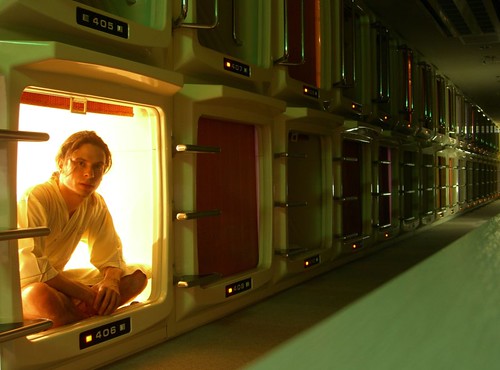
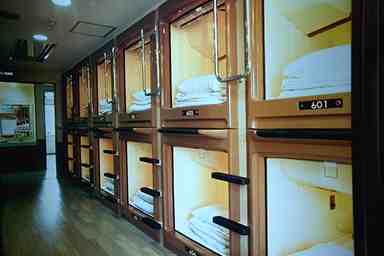
I realized that I missed my "How the Other Half Lives" blog, and wanted to share something that a friend of mine from Japan recently showed me. They're called capsule hotels-- google it if you don't believe me. There are just plenty of pictures. They're unbelievable space savers, able to fit enormous amounts of people into absolutely miniature spaces. It's such a compelling part of Japanese culture to me, that a nation should be so successful but be just inherently limited by the simple, unconquerable force of geography.
Now, a lot of the blogs and articles I read about this were of people telling about the night they spent in a capsule hotel, just to see what it was like. But this New York Times article talks about unemployed men and women that stay in capsules every night out of necessity. Apparently they were originally built with the intent of housing workers who had been drinking and missed the last train home (quite a significant population, apparently), but have now become refuges for the unemployed and homeless, who keep their belongings in tiny suitcases and rent the capsules for far less than it would cost to keep an apartment in Tokyo.
That part really got me, that these were never intended to be housing for the desperate. The recession forced many our of their homes, and this was really the only option for staying in the city. I linked this instantly to the tenement houses in Riss' work and was reminded of the absurdly cramped living conditions that families struggled with every day. We certainly saw it in Maggie; she and her family live cramped up against hundreds of other families in the filthy tenements. What boggles my mind about both these situations is the extreme lengths that people will go to in order to stay in the cities. I know Riis mentions that this is centered on the ethnic and cultural communities that formed, and also in both situations for the jobs available in the cities. But could this really be it? I can't personally imagine getting by in such an extremely limited space. I guess I'm just missing that extra factor that's keeping people in the cities from moving away to the countryside, or at least the suburbs. Does anyone have any thoughts on this?
And I guess, to move it into my own life, some of our living spaces here at Colby can be rather cramped as well. Now, it's nothing like the capsule housing or tenements, but there was nothing spacious about my freshman year double. We could certainly choose to live off campus in a house, and in many cases it would be almost more affordable, but most of us choose not too. My reasoning, and I know the reasons of my friends as well, centers around the desire to be in the social scene, to be constantly surrounded by the people I love and in the middle of all the absurdity and fun that can be Colby College's social scene. Maybe that's what keeps people in cities as well, that desire to stay close to the people and places they are comfortable with. Even if that means suffering through the most uncomfortable living.
Ra-Ra-Rewind
In taking a look back over my blog this weekend, I realized that I missed out on writing a blog for Veblen's Theory of the Leisure Class. I'm actually really glad that I'm writing it now though, because I think it raises some really interesting points and makes me look over what we've covered in class so far in a new light.
We covered chapters on Conspicuous Leisure and Conspicuous Consumption. Each of these themes cover the idea that the leisure class must live their lives in a very outwardly luxurious manner in order to secure the esteem of their colleges. In a way, this manner of living is almost directed at harvesting jealousy, as it hinges in the innate comparisons that members of the leisure class form with each other. Who has the newest car? Whose house is the largest? Who quit his job and hires servants to press the orange-juicer button? It definitely spoke to many of the works we've read, obviously Gatsby, Silas, and House of Mirth. It even extends to the novels of the lower class as well, specifically Maggie. Maggie's goal is obtain some kind of security and stability in her life, but she certainly feeds off of the outward social richness that Pete provides. She basks in the evenings out, the fancy dinners and shows that put her in a position of public appraisal of her wealth. Pete succumbs as well to the seductive call of social wealth, as his encounter with Nellie sends him off into her arms, as she hails from a higher social class and can therefore offer him a higher position in society. From the lower class to the upper crust, no one is resistant to the temptation of being able to live a conspicuously wealthy lifestyle for purely social reasons.
For a while, I assumed that every work in this class would be sort of in that general vein. It's a very American thing, after all, to compare yourself to others and show off your accomplishments, is it not? I guess I've been taking these paramount ideas of conspicuous leisure and consumption to be overarching truths of America, from the low to the upper classes.
However, reading Grapes of Wrath kind of switched things up for me. The Joad family lives in a state of extreme poverty and wants nothing more than to get to the mythic opulence and comfort of California, the land of "milk and honey". At face value, they're like any other group we've seen in the other novels: striving for wealth. But they're not really striving for wealth, persay, just the wealth of comfort. Of stability, of a lifestyle unburdened by the strains of hunger and need. Grampa simply wants to eat the grapes and let the juice run down his chin; nowhere does he suggest wanting to have anyone watch him do it. Their wealth is based not in the having of things, but in the comfort of the family unit as a whole. Ma's dream is of a white house on a farm-- she doesn't want anything big, just something to contain her loved ones. And at night, when the cars park in impromptu villages, everything is shared, people give to those that need without expecting anything in return.
I wonder of Grapes of Wrath represents a turning point in how America approached wealth. Surely an event as monumental as the Great Depression could have the the potential to restructure the social construction and concept of wealth for the nation. In the light of such nationwide destitution, did we move from a nation of show-offs to a nation of bare-necessities? Was this a permanent change, or did it revert right back to conspicuous leisure and consumption once the nation had pulled itself out of the depression? Or is this portrait of "wealth is family" America unique to the impoverished farmland families of the Great Depression? I'd be very interested to see what the wealthy were doing during the Depression. Did they live their wealth just as blatantly, or lay low? I'll be interested to see how the remaining novels in this course approach this issue.
Friday, April 8, 2011
Play Spent
Obviously, I am all about the online games. I found this one in an online search about homelessness for a project I was doing for another class. It's called Spent, and it takes you through what a month might look like as an unemployed member of the modern day extreme lower class. You start out with a budget of $1000 and navigate the month of bills, food, and surprise expenses.
I started out knowing that I'd make it through. I was a smart kid, I get by on my loan-burdened college kid budget, so I should be able to handle this. And I did. I ended the month with around $300 dollars. But the situations that Spent put in my way definitely made me reconsider the kind of person I was or what I would do to stay afloat.
In one situation, I had surprise medical bill that sapped a chunk of my finances and was struggling to get toward payday. With a few days left to go and more groceries to by, I got a popup that said that one of my children got a birthday card in the mail from his Grandma that contained $10. The game asked me if I would keep the money, or let him hold on to it. I thought it out-- sure I could let him keep it, but he'd probably just buy a toy or something. I was the adult, right? I had to make the best decision for everyone, right? I knew that I'd be back on my feet at some point, and I could always just pay him back later. So I kept the $10 and used it to buy groceries.
In another scenario, our family pet got ill. A vet visit would have been around $1000, euthanasia about $50. The third option was to let it suffer. I wanted to do something, but pay day was still a long way off and I had to think about food. So I let it suffer.
After playing this game, I actually had to sit back for a few minutes and sort myself out. It was amazing how personal it got, how it forced you into some pretty unthinkable life situations that seem unreal but are actually very present in the lives of thousands of Americans every day. Spent definitely got to me. I'll be honest-- being at Colby can be overwhelming, and I definitely get jealous of some of the beachside vacations and luxury clothes that my family doesn't really have access to. But this game put it all in perspective for me.
It also tuned me in to some things I didn't really connect with or understand about the Grapes of Wrath. The big thing was the driving force of food. The whole focus of the novel was centered around feeding the family, on reaching a land of abundant fruit and work. I guess it didn't make sense to be because I've never actually experienced not having enough money for food. It's not that I didn't believe that they truly were struggling to feed themselves, I just couldn't connect with the idea of that level of poverty.
I won't claim now to know exactly what it's like to be struggling to that degree, but Spent definitely gave me some perspective for The Grapes of Wrath and for my own life. I would totally recommend it, I feel like a lot of the Colby would totally benefit from reading a thing like this.
Saturday, April 2, 2011
The Grapes of Wrath and the Green Light
I found this little cartoon on a Google image search for "grapes of wrath". Creative, I know, but this is usually my go-to method for looking for blog ideas, and I think this photo actually brings up a pretty fascinating idea when we start to compare what was happening in Depression-Era America with what is happening in the country today.
I'm at first really hesitant to jump to the "compare then and now" idea because at face value, then and now seem so obscenely different that it seems unfair and almost blasphemous to try to draw similarities. People were literally starving to death, farms evicted and destroyed by the hundreds of thousands, and in the present day, we have a horde of college grads that are going back home to live in their parents' basements. Men jumped out of windows then; men have to take out loans now. Coming from a family that has certainly understood the effects of the recent economic climate, I certainly understand that it's bad. But is it that bad? One assumes, of course not.
But then I took a little step back and considered it all again. What makes me reconsider my attitude towards two so drastically different periods in the American economy is the difference that I see in Americans' opinions of the future. Take the above cartoon, for example. It's a clear parody of the Grapes of Wrath journey across America, done in reverse from Nevada to Oklahoma. The family is fleeing some sort of poverty and moving back in with the Grandparents. Perhaps it's a commentary on a trend of families consolidating across generations to save money; perhaps it's a jab at today's economy being so bad that we'd rather be back on the farm with Granma and Grampa. I'm not sure. What it made me consider, though, is how our hopes for the future have changed, from then to now. The Joad family chased the dream of California across the country with an almost humorously hopeless fervor; we, as the audience, saw the tragic, dramatic irony of Pa and his bulletin about the 800 workers needed for fruit picking and the way he clung to it from stop to stop. It was clear that California was no paradise, but with the stubborn insistence of the Joad family that they were headed for peaches and grapes straight off the vine, they pressed on despite all signs of disaster. They had in them such a singular, shared hope-- such a driving force that held them together and pushed them forward.
I think this is the biggest difference between then and now, and the difference that carries the heaviest implications. What are we striving for? What gets us out of bed in the morning to press onward, what makes us fight against the inevitable in spite of how impossible it may seem? I don't know, and I don't know if we know either. I'm not sure that present-day America has a really good feel for what it's working for, for that optimism that things do get better. Do we even feel that things can get better? Even though the American Dream was tragically foolish and futile at times, it was centered around an undying optimism that could outlast even the most profound poverty. I don't know if we have that any more, and that definitely makes me nervous about where we, as a country, stand now, and where we're headed. Anybody else have any ideas about all this?
I'm at first really hesitant to jump to the "compare then and now" idea because at face value, then and now seem so obscenely different that it seems unfair and almost blasphemous to try to draw similarities. People were literally starving to death, farms evicted and destroyed by the hundreds of thousands, and in the present day, we have a horde of college grads that are going back home to live in their parents' basements. Men jumped out of windows then; men have to take out loans now. Coming from a family that has certainly understood the effects of the recent economic climate, I certainly understand that it's bad. But is it that bad? One assumes, of course not.
But then I took a little step back and considered it all again. What makes me reconsider my attitude towards two so drastically different periods in the American economy is the difference that I see in Americans' opinions of the future. Take the above cartoon, for example. It's a clear parody of the Grapes of Wrath journey across America, done in reverse from Nevada to Oklahoma. The family is fleeing some sort of poverty and moving back in with the Grandparents. Perhaps it's a commentary on a trend of families consolidating across generations to save money; perhaps it's a jab at today's economy being so bad that we'd rather be back on the farm with Granma and Grampa. I'm not sure. What it made me consider, though, is how our hopes for the future have changed, from then to now. The Joad family chased the dream of California across the country with an almost humorously hopeless fervor; we, as the audience, saw the tragic, dramatic irony of Pa and his bulletin about the 800 workers needed for fruit picking and the way he clung to it from stop to stop. It was clear that California was no paradise, but with the stubborn insistence of the Joad family that they were headed for peaches and grapes straight off the vine, they pressed on despite all signs of disaster. They had in them such a singular, shared hope-- such a driving force that held them together and pushed them forward.
I think this is the biggest difference between then and now, and the difference that carries the heaviest implications. What are we striving for? What gets us out of bed in the morning to press onward, what makes us fight against the inevitable in spite of how impossible it may seem? I don't know, and I don't know if we know either. I'm not sure that present-day America has a really good feel for what it's working for, for that optimism that things do get better. Do we even feel that things can get better? Even though the American Dream was tragically foolish and futile at times, it was centered around an undying optimism that could outlast even the most profound poverty. I don't know if we have that any more, and that definitely makes me nervous about where we, as a country, stand now, and where we're headed. Anybody else have any ideas about all this?
Sunday, March 13, 2011
"OMGWTF, Gatsby!"
It's been a few years since I read Gatsby, and I've found that I've absolutely loved coming back to it. It really is such a beautiful, lyrical read, and I keep underlining passages that pull at me. Most of the book, I want to read out loud, I want to have it read to me, I want to fall asleep to Fitzgerald's long descriptions of Gatsby's parties and wake up to the Valley of Ashes. I could read most of the book every day of my life, I think. But not all of it.
I've realized, upon this reading, how very much the dialogue drives me nuts. Take, for instance, this conversation between Catherine and Mrs. McKee at Tom's flat in New York in Chapter II.
"When they do get married," continued Catherine, "they're going West to lie for a while until it blows over."
"It'd be more discreet to go to Europe."
"Oh, do you like Europe?" she exclaimed surprisingly. " I just got back from Monte Carlo."
"Really."
"Just last year. I went over there with another girl."
"Stay long?"
"No, we just went to Monte Carlo and back. We went by way f Marseilles. We had over twelve hundred dollars when we started, but we got gypped out of it all in two days in the private rooms. We had an awful time getting back, I can tell you. God, how I hated that town!" p.34
I read passages like this and just go crazy. Their livelihoods revolve around gossip and social interaction, and their analysis of life events is surface-level and shallow. I mean, I'd hate to throw something like this into the mix as a means of comparison, but I really can't help it. Gatsby's dialogue is better (except when he's around Daisy), but the majority of characters in this novel are always crying out, nodding their heads, and gazing off distantly. It's absurd to me.
Of course, I took a step back and gave it another thought. I realized that this was F. Scott Fitzgerald and it's an exceptionally short novel, and if he wanted to put something in his work then there sure as hell was a good reason for it. So I'm caught between two theories on this.
One, that Fitzgerald really wants to set this mood of emptiness and idiocy in his work and includes these trains of dialogue as a way of drawing the reader into the sense of emptiness and lack of substance. It's a true reflection of the idle rich and communicates Fitzgerald's commentary on the lack of substance or meaning in the upper crust.
Two, their dialogue is actually ripe with meaning beneath the guise of being utterly inane. While on the surface, it seems like nothing these people are saying to each other matters, but underneath lies a current of meaning and social commentary. This is actually compelling and fairly ironic, that people with so little to say could say so much. They're a bunch of beautiful people with simple lives and no responsibility, so what could it mean that Fitzgerald might employ their empty dialogue to communicate his deeper meaning?
Do you feel lucky?
We talked about Lily's excessive gambling in class, and discussed how she gambles away a good deal of her livelihood that could be spent on the lavish lifestyle she wants so badly. She does have a decent amount of money; if she were to save wisely, she could easily provide for herself and be comfortable as a single woman. However, Lily's eyes are on the prize, so to speak, and she instead relies on luck to get to where she wants to be.
This idea of luck is pervasive in House of Mirth. You can see it not only in all the characters' gambling tendencies, but also in the way Lily approaches suitors and marriage. In the novel-- and hinted in her past as well-- Lily turns down certain men under the idea and hope that there's an even better, richer, more socially powerful man on his way. It's this approach towards gambling that has brought Lily here in the first place, to the state of being in her late twenties and without the security of marriage.
I started to wonder how this could be, how Lily could be so flagrant with her disregard of consequences when gambling with her future. She loses big in stocks and loses frequently in bridge-- why can't she learn from these mistakes and apply them to the grander scheme of her life? I wonder if Lily has ever really fallen hard, really felt the consequences of her gambling approach to life. With the suitors, a failure with one certainly wouldn't feel permanent, because there are so many suitors out there and she is just so young and pretty.
What Lily fails to really get a grasp on, I think, is the actual weight of the chips she gambles with. These are her beauty, her youth, and her future. The people she associates with are either young, fun, and single, or old, secure, and married. I feel like Lily believes that one can be only either young/fun/single, or old/secure/married-- never a mix of these two spheres. It doesn't once truly occur to her that she can be old and single, and so she doesn't realize how much weight lies in the chips she holds. Even when they're gone, their "goneness" feels impermanent and fixable.
I guess what I'm getting down to is that I feel like Lily has trouble with absolutes, with final endings and permanent changes. She just doesn't believe that they exist. This is something I've struggled with in my own life as well, an obliviousness to the idea that my actions may have permanent results. I really connect with Lily here; I think we both ignore the idea "foreverness" as a sort of self-preservation tactic. It's a lot easier to take gambles here and there if you're not quite in touch with the reality of losing.
Subscribe to:
Posts (Atom)